
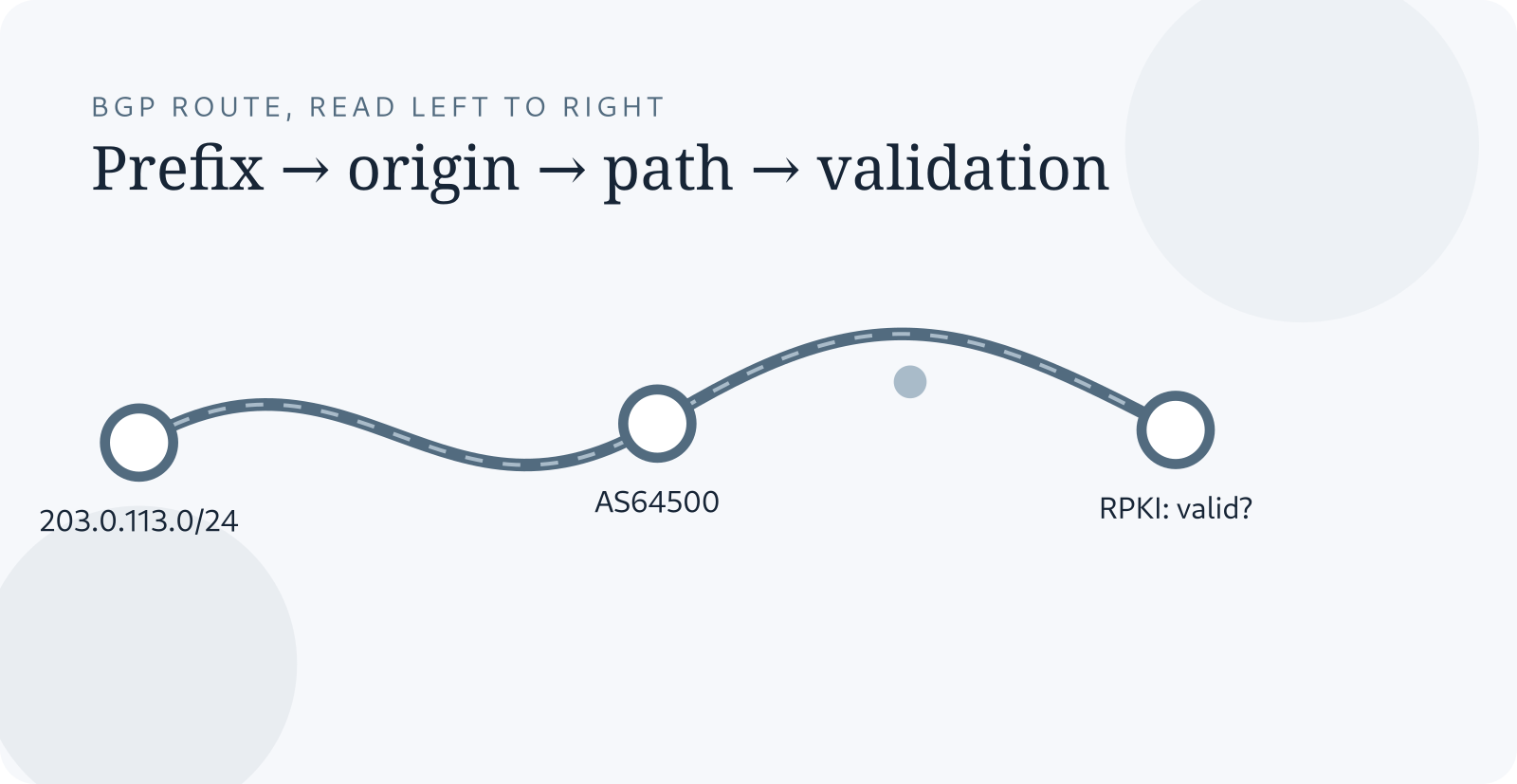
BGP data has a reputation for looking more complicated than it is. A route can arrive as a dense block of prefixes, autonomous system numbers, path attributes, and validation states, but most real investigations begin with four questions: what prefix is being announced, who originates it, which AS path is visible, and does the origin match the expected routing policy?
Start with the prefix, not the IP address
An IP address is useful as an entry point, but routers exchange reachability for prefixes. If you are troubleshooting an address such as 203.0.113.25, the meaningful BGP object might be a covering /24, /22, or another network block. The first job is to identify the route that actually covers the address.
This matters because routers normally prefer the most-specific matching route. A surprise /24 inside a familiar /22 can pull traffic away from the broader route even if the larger block still looks normal. That is why more-specific announcements are one of the first things operators inspect during a suspected hijack or route leak.
Then ask: which ASN is claiming the route?
The origin ASN is the autonomous system at the end of the AS path—the network presenting itself as the origin of that prefix. If you operate the prefix, you should know which origin ASNs are expected. If you are investigating someone else’s network, compare the current origin with registration data, published routing policy, RPKI records, and the network’s normal history before jumping to conclusions.
Read the AS path as a story, not a score
The AS path is a sequence of networks that a route advertisement has traversed. Shorter paths are often preferred, but “shortest” is not the same as “best” because local preference and operator policy can override simple path length. What matters during troubleshooting is whether the path makes sense for the geography and relationships you expect.
A path that suddenly includes an unfamiliar transit provider, loops through an implausible region, or differs sharply between collectors is worth comparing. A BGP lookup gives you the route itself; a looking glass gives you another network’s view of that route. When a problem only affects one region, multiple outside views are much more useful than repeatedly pinging from your desk.
RPKI answers a narrow but important question
RPKI origin validation checks whether a published Route Origin Authorization permits a given ASN to originate a prefix of that length. A result is usually described as valid, invalid, or not found / unknown. Invalid is meaningful because it indicates a mismatch between the announcement and the authorization—but it still needs context. Stale ROAs, legitimate migrations, and configuration mistakes happen.
The right workflow is to combine RPKI with the observed route, not treat it as a magical reputation score. The bgplookup.io network toolkit places BGP, looking-glass, RPKI, IRR, PeeringDB, WHOIS/RDAP, DNS, and related tools in the same investigation flow so you can move from one piece of evidence to the next without losing the resource you started with.
A five-minute route check
- Identify the covering prefix. Confirm the longest route that contains the IP.
- Check the origin ASN. Compare it with what you expect from the network or registration context.
- Look for more-specifics. A new longer prefix can change traffic even when the aggregate remains present.
- Compare AS paths from more than one vantage point. Regional differences are often the clue.
- Check RPKI and routing policy. Treat them as corroborating evidence, not verdicts.
The part that saves the most time
Good routing work is mostly disciplined comparison. Instead of asking “is BGP broken?”, ask a smaller question: what changed between the path that works and the path that fails? That framing turns a wall of routing data into a set of testable differences.
If you want a practical place to start, open bgplookup.io with the affected IP, prefix, ASN, or domain and follow the evidence outward. The goal is not to memorize every attribute. It is to recognize which field answers the next useful question.
Explore the brand: bgplookup · View its LogicWeb Network profile