
The internet can deliver more news before breakfast than anyone could responsibly process in a day. The usual response is to skim faster, open more tabs, and hope that volume eventually turns into understanding. It rarely does.
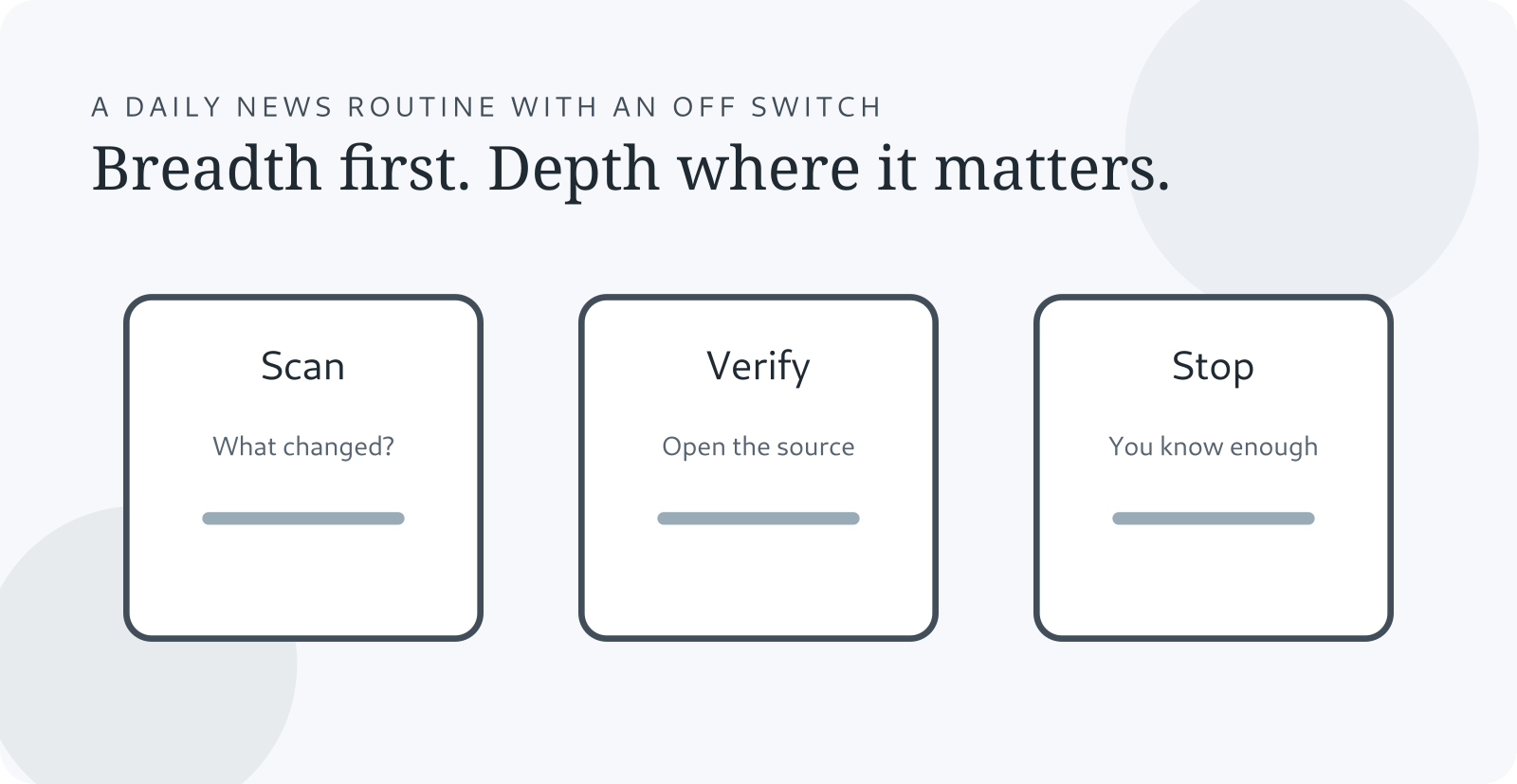
Begin with breadth, not depth
A useful first pass through the news should answer one question: what changed? Scan across several categories—local or national news, world events, technology, science, health, finance, or the subjects that materially affect your work and family. You are building a map, not writing a dissertation.
TruthMedia is structured around a daily edition with multiple sections and source choices. The idea is useful even if you read elsewhere: begin with a broad desk, then decide which stories deserve deeper attention.
Separate “interesting” from “important”
A story can be fascinating without changing anything you need to know or do. Another story may look boring but affect your business, community, health decisions, or public policy. When every headline competes with the same visual urgency, you have to supply your own priority.
One practical method is to mark only two or three stories for deeper reading. Everything else remains awareness-level information unless new facts make it more important later.
Open the source when the claim matters
If a headline makes a specific factual claim that could affect a decision, open the underlying reporting. Look for named sources, documents, direct quotations, data, court filings, official statements, or links to primary material. If the article summarizes another outlet’s reporting, consider opening the original.
This is especially important with breaking news. Early reports are often incomplete. A second article published an hour later may correct a name, number, motive, or sequence of events.
Know what kind of piece you are reading
News reporting, analysis, opinion, aggregation, and commentary are different genres. Problems begin when readers treat them as interchangeable. An opinion column can be valuable, but it is trying to persuade. An analysis piece may explain implications beyond the known facts. An aggregator may be useful for discovery but depend on another source for original reporting.
Do not demand “neutrality” from a clearly labeled opinion piece; demand honest labeling. Likewise, do not let an analysis piece borrow the authority of straight reporting without showing where interpretation begins.
Choose a few sources on purpose
Trying to balance every outlet against every other outlet is exhausting. A more sustainable approach is to keep a small set of sources with different strengths: one strong local source, one or two national sources, a reliable wire or primary-source feed, and specialized outlets for the subjects you actually follow.
Then use discovery tools to broaden the desk rather than replace it. TruthMedia’s source-selection model can be useful here because it makes the source itself visible as part of the reading experience.
Set an off switch
A news habit becomes unhealthy when it has no natural end. Decide in advance what “informed enough for now” means. That might be twenty minutes in the morning and a short evening update, or one daily edition plus alerts for genuinely urgent events.
If nothing has materially changed, refreshing the same story every six minutes does not make you more informed. It makes you more activated.
A practical 20-minute routine
- Five minutes: scan the major sections and note what changed.
- Ten minutes: open two or three stories that matter most.
- Three minutes: verify one consequential claim with the original source or another independent source.
- Two minutes: save anything you genuinely need to return to, then stop.
The goal is orientation, not omniscience
No one is fully caught up. The news cycle does not have an end state. A strong daily news habit gives you a reliable sense of the world, helps you distinguish reporting from reaction, and makes it easier to go deeper when the subject deserves it.
Being informed is not the same as being continuously exposed. Build a desk you trust, follow the evidence when the stakes rise, and leave enough attention for the rest of your life.
Explore the brand: truthmedia · View its LogicWeb Network profile