
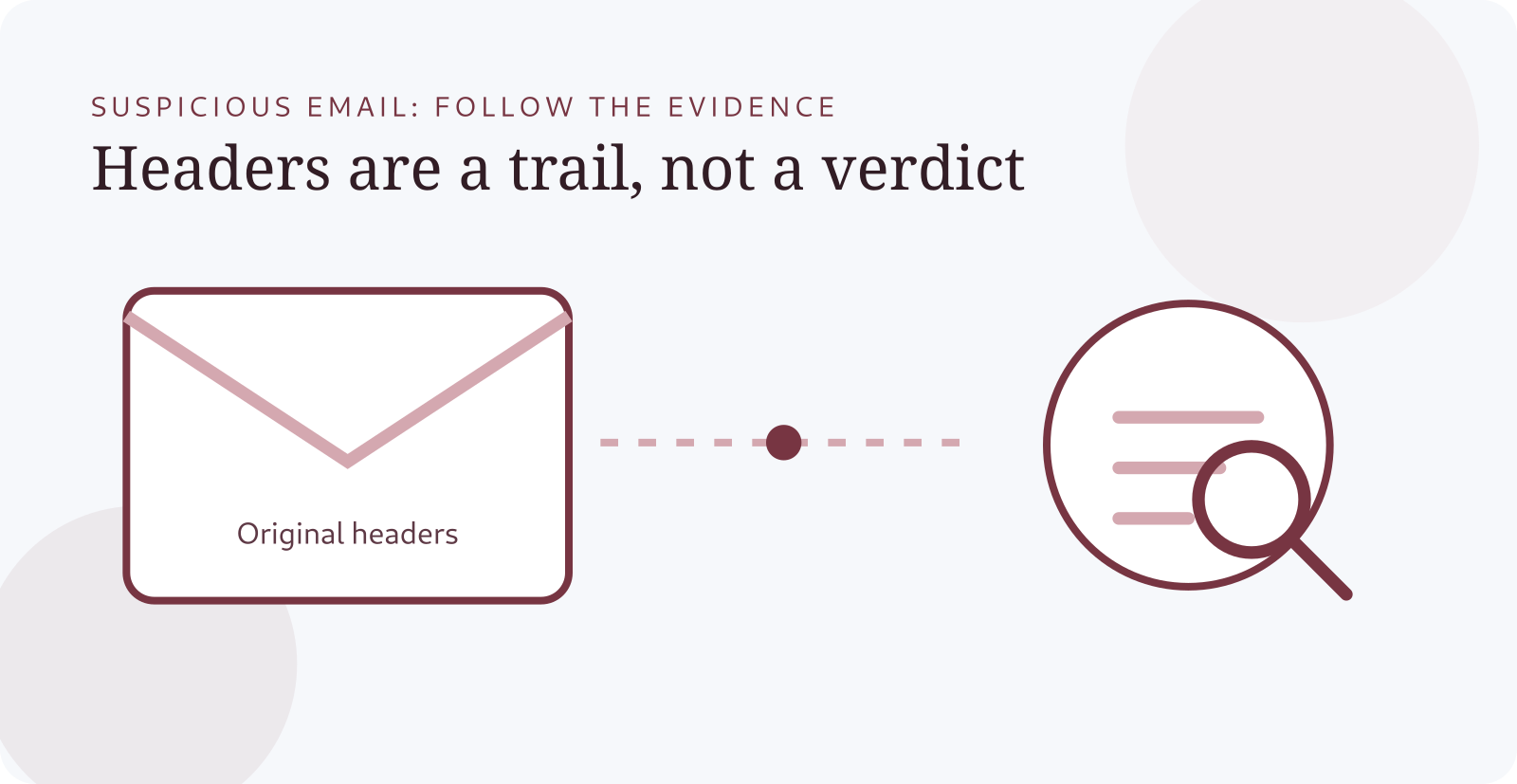
A screenshot of a suspicious email can show you what the message looked like. It usually cannot show you how the message traveled. For that, you need the original email headers—the delivery metadata added as the message moves between systems.
Keep the original evidence
If you think a message may be spam, phishing, or abuse, preserve the original message or export an .eml file before forwarding it around. Copying the visible body into a new email can destroy the metadata you need for an investigation. A screenshot loses even more.
ReportSpam is built around this distinction. Its public reporting flow asks for original headers or an EML file, and it explicitly separates submission from a later public listing decision. That is important: an IP appearing in a header is evidence to examine, not an automatic conviction.
Read Received headers from the bottom up
Most mail systems prepend a Received: line when they accept a message. The newest hop is typically near the top; the older hops are lower down. You are looking for the earliest trustworthy handoff into infrastructure you can identify.
Do not blindly trust every line. A sender can forge headers before the message reaches a real mail server. The useful boundary is where independently operated infrastructure begins adding its own timestamps and connection details.
Authentication results help, but they answer specific questions
- SPF asks whether the sending IP is authorized for the domain being checked.
- DKIM checks whether a signed portion of the message validates against a public key published in DNS.
- DMARC evaluates alignment and policy using SPF and/or DKIM results.
A passing result does not mean the email is harmless. Attackers can send from compromised or legitimately configured domains. A failing result does not automatically mean malice either; broken forwarding and bad configuration exist. Treat authentication as one piece of the case.
Investigate the infrastructure separately from the message
Once you have a candidate sending IP or domain, look up ownership, ASN, reverse DNS, registration data, abuse contacts, and relevant DNS records. This tells you who operates the infrastructure and where a report can reasonably go.
ReportSpam’s investigation tools are designed to keep those layers separate: observed data, enrichment, external reputation sources, and reviewed local decisions are not supposed to collapse into one mystery score. That makes the result easier to challenge and easier to explain.
A practical suspicious-email workflow
- Save the original email or EML file.
- Inspect the earliest trustworthy
Receivedhop. - Review SPF, DKIM, and DMARC results.
- Check the candidate IP/domain ownership and abuse contact.
- Compare the visible sender with the authenticated domain.
- Look for corroborating evidence before making an attribution claim.
- If you report it, retain the receipt or case reference.
What not to do
Do not publicly accuse an ISP or individual because one header contains their IP. Do not assume a residential IP is the attacker rather than a compromised device. Do not assume a domain with valid DKIM is trustworthy. And do not post full headers publicly without checking whether they contain personal addresses or other sensitive information.
The goal is a defensible next step
A good investigation should end with a clear statement such as: “This message was accepted from this IP by this server at this time; the authenticated domain was this; the infrastructure is registered to this network; and this is the appropriate abuse contact.” That is much more useful than “this looks suspicious.”
Spam analysis gets better when it becomes less dramatic. Preserve the evidence, separate observation from inference, and make each conclusion traceable to something another person can verify.
Explore the brand: reportspam · View its LogicWeb Network profile