
Streaming solved the problem of not having enough to watch and replaced it with a new one: having thousands of choices and no obvious way to decide. You can spend twenty minutes browsing, open three trailers, debate a rating, discover the title is on the wrong service, and somehow end up watching nothing.
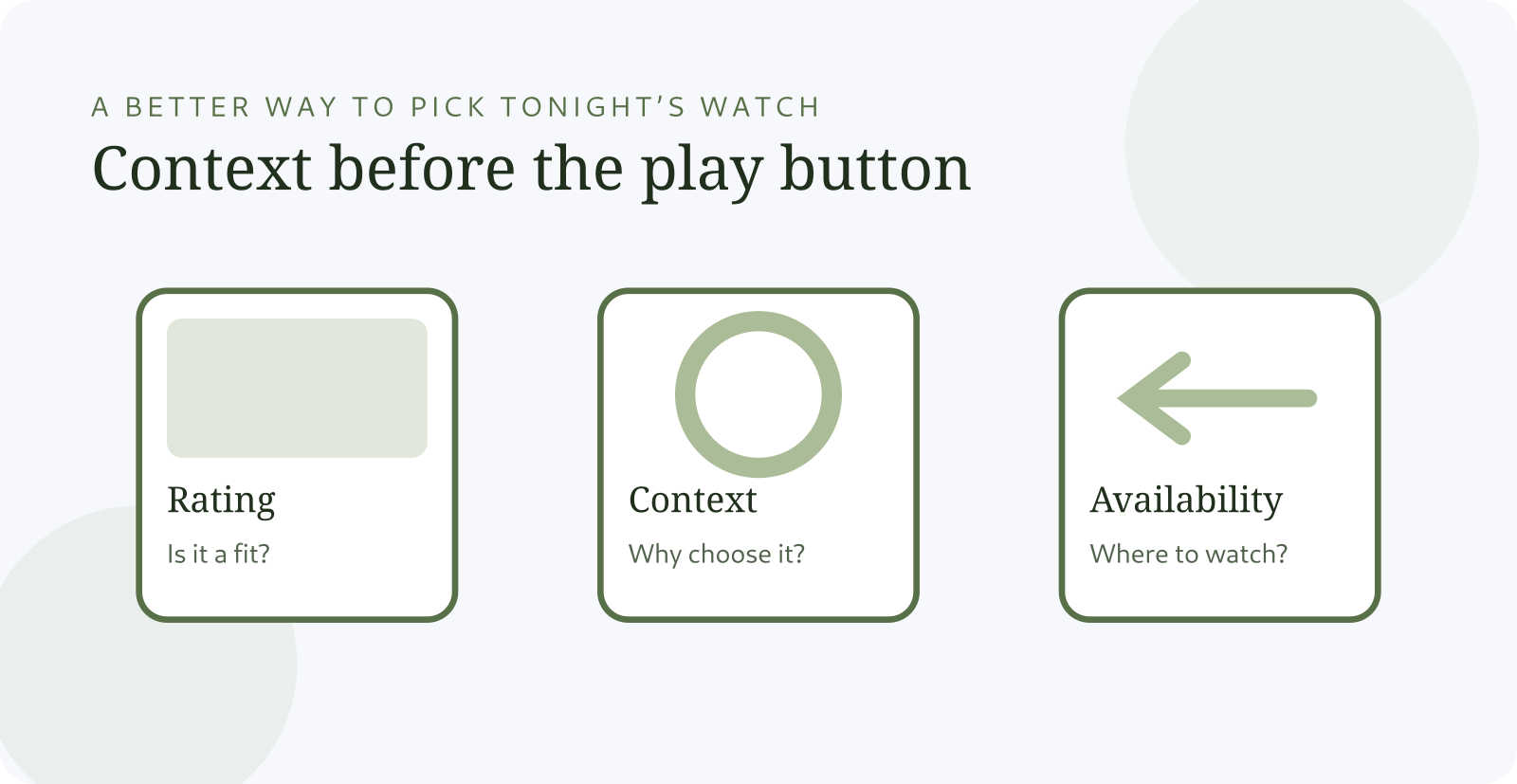
A rating is a starting point, not the whole decision
Age and content ratings are useful because they compress a lot of information into something you can scan. But two titles with the same rating can feel very different. One might be intense because of sustained peril. Another may receive the same rating for language or a single scene. Families also differ in what they are comfortable with and why.
That is why the useful question is not simply “Is this family friendly?” It is “Is this a good fit for this household, tonight?”
Context is what turns a catalog into a decision tool
PureRated organizes movies, series, documentaries, sermons, podcasts, YouTube videos, shorts, and themed collections around the idea that discovery should come with enough context to make a choice. Its public catalog currently includes conventional entertainment alongside faith-focused teaching and Bible content, with links out to available services.
The strongest part of that model is the separation between curation and choice. A title being present in a catalog is not a blanket endorsement. It is an invitation to inspect the information and decide for yourself.
Use a three-question filter
When a family night gets stuck in scroll mode, ask three questions before you open another app:
- What mood are we actually in? Gentle, funny, adventurous, educational, reflective, faith-focused, or documentary?
- How much time do we have? A 25-minute episode and a two-hour film solve different problems.
- What do we want to avoid or prioritize? Age appropriateness, intensity, language, subject matter, faith content, or something suitable for younger children?
Those three answers cut the search space dramatically. A good catalog lets you browse by theme and type instead of pretending all content belongs in one infinite row.
Collections are underrated
Search works when you know what you want. Collections work when you only know the kind of evening you want. A “Sunday afternoon” collection, nature documentaries, faith and courage, parenting, Bible history, or lighter comfort viewing gives the browsing session a point of view.
That is especially useful when several people are choosing together. It is easier to agree on a category than on a specific title from a homepage full of personalized recommendations.
Check where it is actually available
A recommendation is not very helpful if it lives on a service you do not have. Before you sell the room on a title, check the current availability link. Streaming rights move, regional catalogs differ, and a title can disappear from one service while appearing on another.
Make “good enough to press play” the goal
The paradox of streaming is that maximizing choice can reduce satisfaction. At some point, more searching stops improving the decision. Once you have a title that fits the mood, time, household standards, and services you already use, press play.
That is what a curated catalog should do well: shorten the distance between “we want to watch something” and “this looks like a good fit.” The win is not perfect certainty. The win is less scrolling and more time actually sharing the story.
Explore the brand: purerated · View its LogicWeb Network profile