
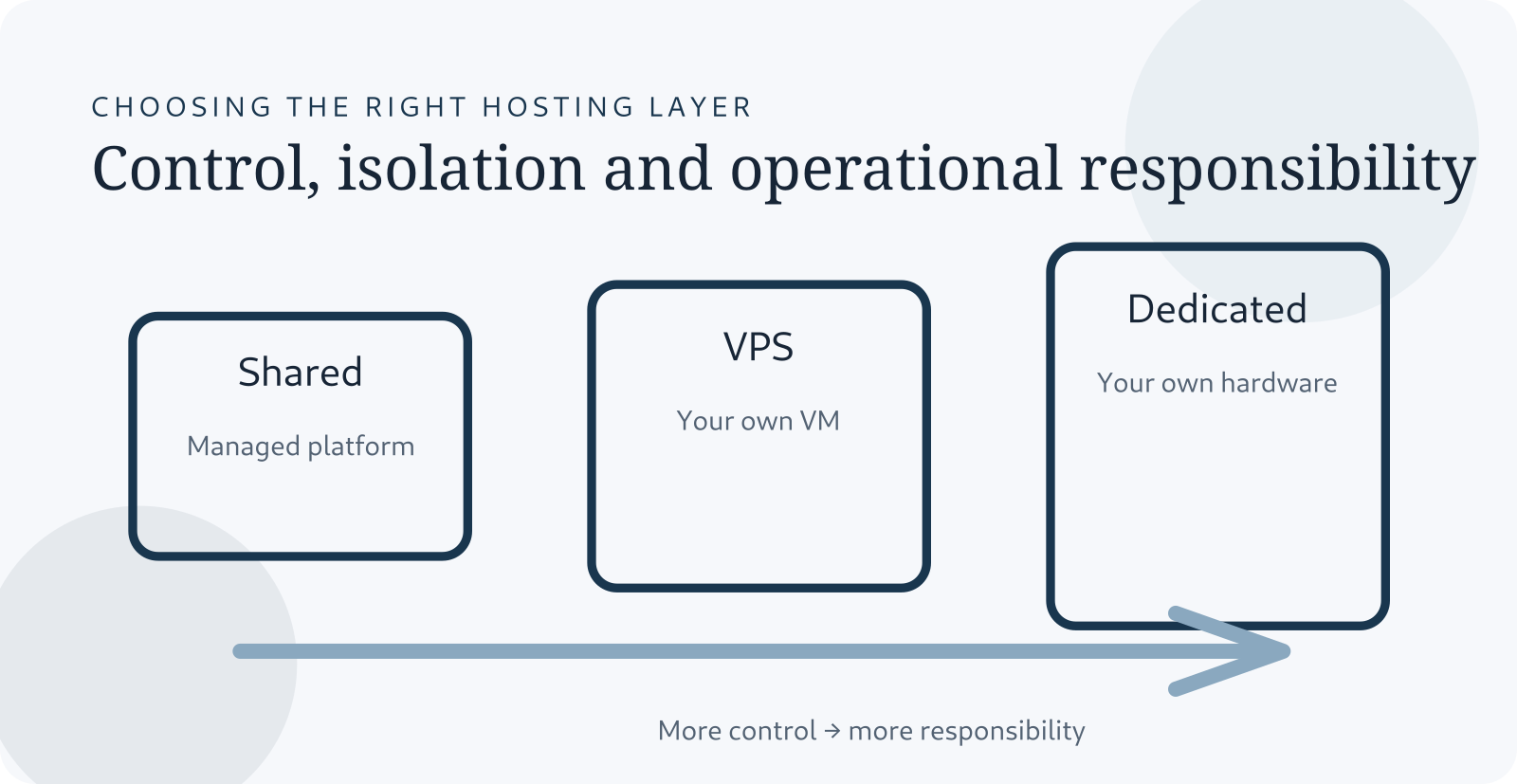
Hosting plans are usually marketed as a ladder: shared hosting at the bottom, VPS in the middle, dedicated servers at the top. That is convenient, but it hides the more useful distinction. As you move up the stack, you are not simply buying “more power.” You are buying more isolation, more control, and more operational responsibility.
Shared hosting: the platform does more for you
Shared hosting is a good fit when the application is conventional and you want the hosting company to own most of the system administration. You typically get a control panel, web server, PHP versions, databases, email, SSL automation, backups, and account-level security without managing the underlying operating system yourself.
That can be exactly the right trade-off for a business site, a brochure site, a blog, or a moderate WordPress workload. The constraint is that you live inside the provider’s platform. You usually cannot load arbitrary kernel modules, replace the system firewall, or redesign the server stack from scratch.
A VPS changes the boundary
A true KVM VPS gives you a virtual machine with its own kernel and root access. That means you can choose the operating system, control packages and services, tune the web stack, run containers, build VPNs, host APIs, or deploy software that would not fit inside a shared hosting account.
The trade-off is that patching, firewall rules, backups, monitoring, service configuration, and incident recovery become more explicitly your responsibility unless you buy management. If you want to understand why this matters, LogicWeb’s knowledge base explains that KVM virtualizes a complete guest rather than placing you inside a container that shares the host kernel.
Dedicated servers are about isolation and predictable ownership
A dedicated server removes the virtualization layer between your workload and the physical machine. You control the chassis resources, storage layout, and network configuration to a much greater degree. That makes sense for workloads with sustained CPU demand, large memory requirements, specialized storage needs, high packet rates, or licensing and compliance requirements that benefit from dedicated hardware.
It also means hardware selection matters more. CPU family, core count, memory capacity, storage redundancy, remote management, uplink size, DDoS protection, and replacement procedures are all part of the decision.
Latency can matter before raw horsepower does
A small server in the right location can feel faster than a larger server an ocean away. Dynamic WordPress pages, checkout requests, control panels, API calls, and database round trips all expose latency. If most of your users are in Europe, placing an origin in Europe may improve the experience more than doubling CPU cores in a distant city.
LogicWeb currently offers VPS locations across multiple regions, and its own guidance emphasizes choosing a datacenter based on real user traffic, checkout paths, and the systems your application depends on—not simply choosing the city closest to your desk.
The migration question is really an operations question
Before moving from shared hosting to a VPS, ask who will maintain the machine after launch. Who applies security updates? Who checks backups? Who notices when disk space is nearly full? Who responds if a service fails at 3 a.m.? A VPS gives you freedom, but freedom without an operating plan is just another failure mode.
Likewise, do not jump from a VPS to dedicated hardware just because a benchmark looks attractive. Measure the actual bottleneck. If CPU is mostly idle and the problem is slow database queries, more hardware may only make the same inefficiency more expensive.
A simple decision framework
- Choose shared hosting when your stack is standard and you value convenience, built-in tooling, and less system administration.
- Choose a VPS when you need root access, your own kernel, custom services, containers, networking control, or more predictable isolation.
- Choose dedicated when sustained resource demand, hardware control, storage architecture, network throughput, or business requirements justify a physical machine.
Scale because the workload asks for it
The best hosting tier is the least complicated one that gives the application the control and resources it genuinely needs. If your site is happy on shared hosting, there is no prize for moving it. If your workload needs a custom stack, a VPS can be liberating. If your VPS is consistently pushing against hardware boundaries, dedicated becomes a rational next step.
Infrastructure is healthiest when it is boring: capacity is intentional, backups are tested, monitoring is useful, and the platform is understandable enough that someone can fix it when the day goes sideways.
Explore the brand: logicweb · View its LogicWeb Network profile